The Birth of the First Corvette
This is an excerpt from my book Corvette: The Evolution of an American Icon, available in the Bookstore section.
1953: The Birth of The American Sports Car
In the 1940s and 1950s, European car enthusiasts enjoyed driving smaller, nimble two-seater automobiles, such as the Triumph, Austin-Healey, Jaguar, and, most notably, the MG-TC.
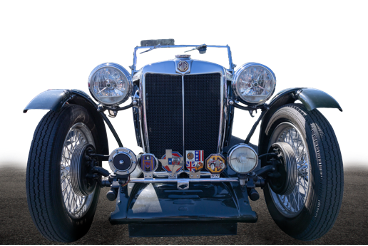
Meanwhile, U.S. car manufacturers offered no options in this category. US companies like Stutz (1913-1938), Mercer (1909-1925), Duesenberg (1920-1937), Cord (1928-1937), Kaiser (1945-1953), Crosley (1946-1952), and Auburn (1909-1937) produced what were considered high-performance cars, but all these brands had ceased operations.
After World War II ended in September 1945, the American automobile industry was eager to return to the art of “selling the sizzle instead of the steak.” Automobile engineers' imaginations ran wild, and cars developed fins and plenty of chrome. It was all about the “sizzle.”
The automobile industry introduced new models in the fall, generating significant public interest. People of my generation (Baby Boomers) will remember the excitement surrounding the unveiling of new models every September. Dealerships in my small hometown of Columbus, Indiana, would set up searchlights to draw locals to their showrooms and display the latest models. The introduction of the new cars was an exciting time of the year that was eagerly anticipated.
In 1949, GM launched its Motorama Exposition program. These extravagant events traveled across the country to attract the public with eye-catching new cars and glimpses of the future.
In 1953, the Chevrolet division of General Motors was experiencing a sales slump. Sales were down nearly 40% from the 1950-52 levels, and the lineup was lackluster. Something new was needed.
American servicemen were returning home from the war, eager to drive sports cars like those they had experienced in Europe. However, no US car manufacturer was meeting their desires.
Harley Earl has a vision…
Harley Earl, General Motors’ Chief of Design, saw the European sports cars dominate at Watson Glen and other races. Furthermore, these European cars were imported to the US in increasingly significant numbers every quarter. The Europeans had discovered a market niche no American car company could match.
Recognizing this void, Earl suggested a solution to the sales slump to Chevrolet brand manager Thomas Keating: a dream sports car! The sports car project was code-named Project Opel, and Harley Earl had a vision for this dream car.
Earl envisioned a two-seater car with a low, ground-hugging profile. The occupants would sit nearly on the car's floor, and the roofline would be extremely low. The weight distribution would be 50/50, from front to rear. The vehicle would be constructed with fiberglass, enabling designers to create sleek shapes and curves that were impossible with metal. The final design featured a 102-inch wheelbase, the same as the Jaguar XK120 that Earl admired.
Many Corvette historians speculate that Harvey Earl’s design for the 1953 Corvette was inspired by the 1947 Cistialia 202.
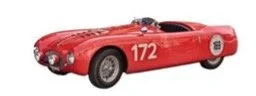
1947 Cistialia 202
This was not the first fiberglass car. In 1952, America’s first fiberglass regular production car was the Woodill Wildfire. The Kaiser company produced the Kaiser-Darrin, which also used fiberglass.
On June 2, 1952, Earl introduced GM’s executives to the Opel project. The polo-white car, with a red interior, was displayed in a darkened room with special lighting that made it glow like a pearl. The executives loved the car, and the project was given top priority. The name” Corvette” was submitted as the name for this “dream car” by Myron Scott, GM's assistant director of Public Relations. The name was chosen from over 300 submitted suggestions. A corvette is a small, agile, 19th-century warship whose name implied speed, maneuverability, and strength…brilliant!! The car was introduced in January 1953 at the Motorama show in New York City’s Waldorf-Astoria Hotel. GM executives hid microphones around the car to capture what the audience said about the vehicle. They heard comments like “It’s cute,” “It’s lovely,” and “I wish I had one.” After the Motorama, GM received approximately 7,000 letters stating that if the car were produced, the writers would buy one! GM put the production on the fast track; they were sure they had a winner.
The first generation of the Corvette ran for ten years and produced the most dramatic changes in body styles and performance of any subsequent generation.
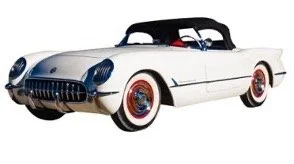
1953 Corvette